
BLOGS

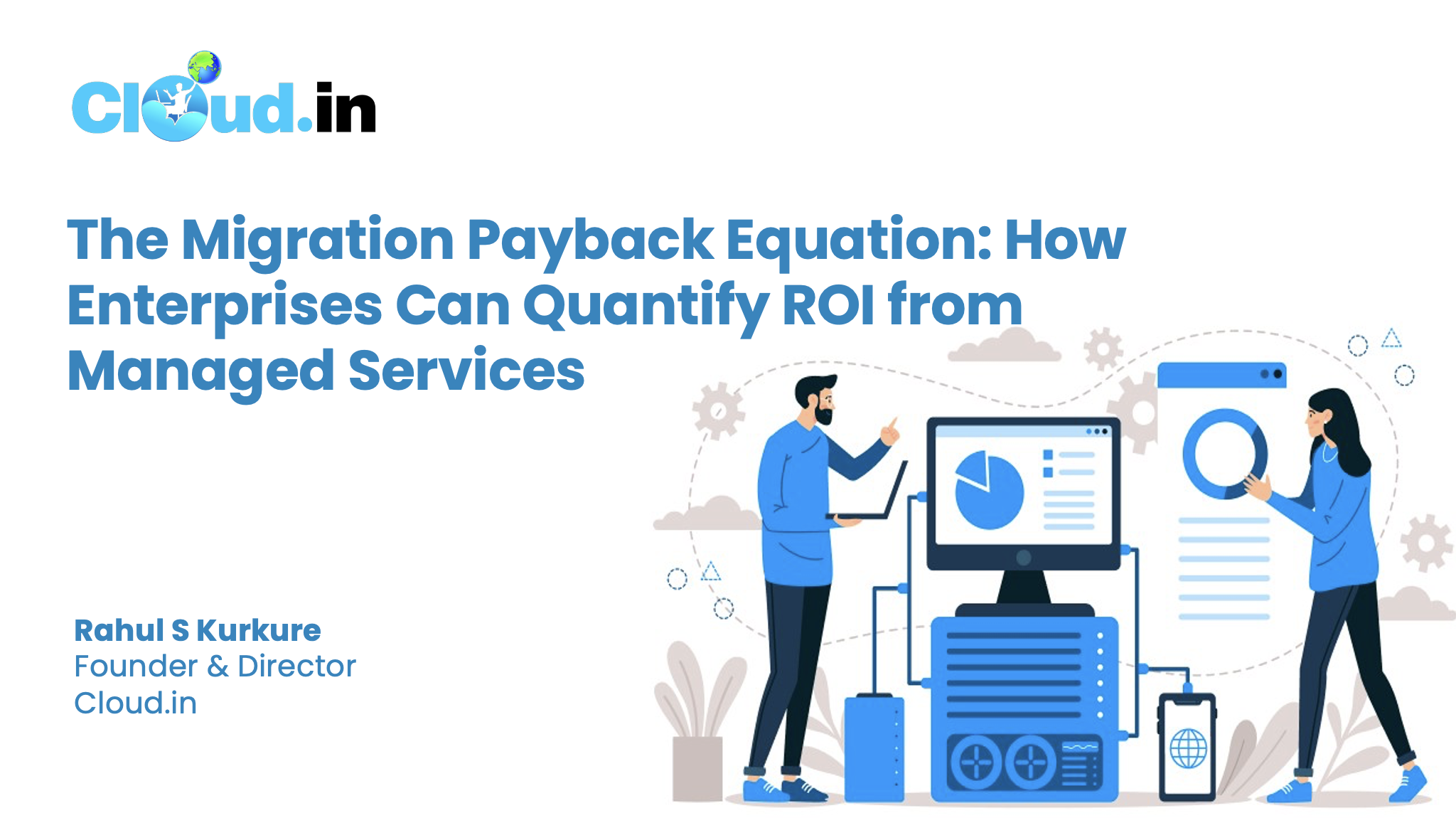
The Migration Payback Equation: How Enterprises Can Quantify ROI from Managed Services : Rahul S Kurkure, Founder & Director, Cloud.in

TECH NEWS

The Migration Payback Equation: How Enterprises Can Quantify ROI from Managed Services : Rahul S Kurkure, Founder & Director, Cloud.in

As organizations are accelerating their digital transformation journeys, migrating to the cloud is becoming inevitable. While in-house teams are vital for internal alignment, a managed services model provides the additional breadth of expertise needed to navigate today’s fast-paced digital transformation. A shift towards managed services has become a strategic necessity and not just an upgrade in operations. By partnering with a managed services provider (MSP), organizations can ensure their IT environments remain optimized, secure, and scalable, enabling them to focus on driving innovation, business agility, and growth. However, one question remains at the center of boardroom discussions - how can enterprises accurately measure the ROI from managed services?Understanding the Migration Payback EquationMigration payback equation is when an investment generates sufficient revenue or value to cover its initial investment and get to the break-even point. To understand how to calculate ROI from managed services, organizations must go beyond comparing operational expenses. They have to evaluate a broader ‘Migration Payback Equation’ that covers cost savings, an increase in revenue, operational agility, risk reduction, gains in productivity, and long-term business value. Establishing and Measuring Real ROI of Managed IT ServicesEstablishing the BaselinePrior to engaging any service provider, organizations have to establish a baseline of their existing IT costs and operational performance. This includes infrastructure investment, cost of licenses, hiring IT teams and related costs, security incident response costs, and idle time expenditure, which includes business losses as well. Partnering Managed IT Services ProviderThe right managed service provider helps organizations bring down operational complexity, enhance security, and provide access to specialized expertise. By working with a Managed Service Provider, organizations have the advantage of optimized cloud resource management, automated monitoring and security, improvement in scalability and performance, and access to certified expertise. Furthermore, to establish a successful partnership, the SLAs should be clearly defined with measurable KPIs.The Context of Cloud Migration ROICost savings are realized through the shift from CAPEX to OPEX, as traditional on-premises data centers and their associated expenses are replaced with flexible, consumption-based pricing models. However, measuring enterprise cloud migration return on investment goes beyond just infrastructure costs. Organizations must evaluate the benefits of resource and staffing efficiency, reduced downtime and performance bottlenecks, unparalleled scalability and flexibility, improved collaboration and mobility, faster time to market, and enhanced security and compliance. In hybrid and multi-cloud environments, measuring hybrid cloud migration ROI becomes even more critical. The context of cloud migration ROI must therefore include both operational and strategic business outcomes.Calculating quantifiable savingsROI is most demonstrable through tangible cost reductions across hardware, operations, and staffing. Instead of requiring internal teams to focus exclusively on time-consuming maintenance, an MSP uses automation to handle routine support and monitoring. This shifts the internal IT focus toward strategic business outcomes while 24/7 oversight ensures that expensive system downtime becomes a thing of the past. Measuring value generation and growthIn addition to cost savings, the real value of managed services is seen in how they enable organizations to deliver better business outcomes. They also add value by ensuring faster time-to-market, operational reliability, better customer engagement and experience, winning customer trust, reduction in operational risks, higher employee productivity, and increased innovation capacity. In today’s data-driven landscape, organizations are increasingly utilizing AI-powered managed services to sharpen decision-making and operational intelligence.. Internal IT teams can focus on higher-end innovation-related initiatives that help in building long-term value, beyond quick financial returns.Incorporating FinOps and Financial GovernanceAs cloud adoption accelerates, many organizations face rising costs due to a lack of structured oversight. By incorporating FinOps and financial governance into MSP partnerships, cloud management becomes a proactive, value-driven strategy, rather than a reactive cost-cutting exercise. It provides real-time visibility into cloud spending, enables optimized resource utilization, and helps in estimating and managing budgets effectively. Financial governance also ensures that ROI measurements remain transparent, measurable, and aligned with organizational growth goals.Ascertaining the migration payback periodDetermining the migration payback period when working with an MSP involves calculating the time required for accumulated monthly savings and efficiency gains to offset the initial migration investment. The payback period depends on factors such as migration complexity, existing infrastructure costs, cloud adoption costs, increase in revenue from the initiative, and improvement in operational efficiency.Choosing the right Managed Services PartnerThe success of any managed services strategy depends significantly on selecting the right partner with experience in deploying and managing mission-critical workloads across different sectors, and having a good understanding of the customer pain points. While evaluating a Managed IT Service Provider, enterprises should consider several critical factors such as proven expertise in cloud migration, robust cybersecurity, compliance capabilities, and expertise in managing hybrid and multi-cloud environment along with automation and AI-driven operational capabilities. The service provider should have transparent pricing and governance models, scalable support, and 24/7 monitoring services. By embracing the Migration Payback Equation, enterprises can gain a holistic understanding of their technology investments and ensure that managed services deliver measurable, sustainable business value in an increasingly digital economy.

The AI-Ready Cloud: Why Infrastructure Modernization Is Emerging  as a Board-Level Cost Priority : Rahul S. Kurkure, Founder & Director, Cloud.in

TECH NEWS

The AI-Ready Cloud: Why Infrastructure Modernization Is Emerging as a Board-Level Cost Priority : Rahul S. Kurkure, Founder & Director, Cloud.in

Over the last decade, organizations across sectors, be it banking, healthcare, manufacturing, retail, or government, have focused on accelerating their digital transformation efforts to enhance efficiency, scalability, and customer experience. Today’s organizations are no longer focused solely on digital transformation; they are transitioning toward AI-driven business operations, where AI, Generative AI, and Large Language models (LLMs) are becoming key to business growth, decision-making, and innovation. This new reality is well understood by business leaders, and infrastructure modernization is quickly becoming a board-level cost priority.The Growing cost of legacy infrastructureDespite this new focus, many organizations continue to rely on legacy, aging systems, including applications, platforms, and IT infrastructure for critical business functions, which represent a significant operational and financial burden. These systems are proving to be inefficient in supporting modern workloads and AI-driven environments. Built before the emergence of AI-driven cyber threats, legacy systems lack advanced security features and pose security risks, giving rise to data breaches, compliance failures, financial losses, reputational damage, and customer churn. Furthermore, enormous costs are incurred due to frequent maintenance, dwindling vendor support, and high-fee custom support. Prone to constant failures and unplanned outages, the legacy systems are responsible for increased downtime, delays in decision-making, and an impact on revenue generation. Being rigid, these obsolete systems are not suitable for smooth integration with cloud platforms and modern applications, reducing operational agility and slowing innovation. In the AI era, agility is becoming a competitive necessity, where organizations have the ability to respond immediately to the ever-changing market demand.Shift from Digital Transformation to AI TransformationTraditional digital transformation covered the strategic integration of digital technologies across operations, automation of manual processes, cloud migration, and modernizing applications, among others. Today, with massive data proliferation and advanced computing power, which is required by AI that is on the rise. For AI transformation to succeed, organizations must leverage a modern data platform with both structured and unstructured data integrated, along with a cloud-native architecture to support AI workloads and large-scale analytics. Furthermore, strong data governance is critical to integrate AI into the organization’s business operations, which helps manage the potential risks the technology poses. However, the introduction of AI infrastructure cannot be supported by traditional cloud architecture, which still exists in several organizations across industry verticals. This AI readiness gap can result in high operational and financial costs, and failing to address this effectively on time has big business implications. Implementing AI tools without modernizing the foundational infrastructure presents numerous challenges, including the lack of effective system scaling, fragmented data pipelines, and the absence of data readiness. By investing in AI without a modern foundational infrastructure, organizations will frequently face productivity and innovation losses.AI workloads demand a new cloud architectureAI workloads are driving organizations to completely redesign their existing cloud infrastructure to suit their needs, where thousands of GPUs should be able to communicate with minimal latency. Massive computational resources are required for the retraining of large-scale AI models. With these workloads having to process huge volumes of data, there is a need for greater computational performance. Specialized AI-optimized hardware architecture is the need of the hour, where organizations have to shift to workload-specific, specialized environments that are designed specifically for AI workloads, from general-purpose computing. It should enable high-speed networking and scalable storage, while rewriting cloud intelligence. High-speed networking reduces latency and bottlenecks while enhancing user experiences. Long-term data retention and real-time analytics are made possible with a scalable storage architecture. Organizations are also rewriting cloud intelligence to optimize operations and identify dynamically while enhancing the organization’s resilience in real-time. Today, hyperscalers are also establishing environments around GPU-based architectures, high-density power and cooling systems for high-performance workloads such as AI. Sustainability and Energy Efficiency Are Becoming Critical PrioritiesWith AI workloads consuming huge amounts of energy, especially in large-scale cloud and data center environments, there is a growing concern about sustainability among board members. They are ensuring all infrastructure modernization strategies meet the ESG goals. AI tools and technologies are assessed for their environmental impact, in addition to the performance they deliver. Organizations are placing a high priority for reduction in carbon footprint as they continue to balance AI growth with sustainable commitments. In high-density AI environments, GPU-intensive workloads generate significant heat, compelling organizations to incorporate the cooling aspects while designing their datacenters.Organizations that are able to successfully modernize their infrastructure are not only meeting their current operational requirements but are laying the foundation for future growth as well. AI-ready infrastructure enables organizations to improve operational efficiency and quicker innovation cycles, as they respond to market changes with speed to launch improvised products. Infrastructure modernization also improves agility and security while scaling operations more efficiently. On the other hand, organizations that delay infrastructure modernizations risk falling behind the competition as the legacy environments they house do not support innovation but instead invite operational risks that can cost them dearly, impacting long-term growth. The future certainly belongs to organizations that establish intelligent, scalable, and sustainable AI-ready infrastructure today.

Securing Hybrid and Multi-Cloud Environments: Strategies for a Resilient Digital Future : Subhash Muthareddy ,  Vice President -Threat and Vulnerability Management (TVM), Inspira Enterprise

TECH NEWS

Securing Hybrid and Multi-Cloud Environments: Strategies for a Resilient Digital Future : Subhash Muthareddy , Vice President -Threat and Vulnerability Management (TVM), Inspira Enterprise

Organizations are rapidly advancing their digital transformation initiatives, increasingly adopting hybrid and multi-cloud environments that integrate on-premises systems with public and multiple cloud platforms. Although this approach offers flexibility, scalability, innovation opportunities, cost-effectiveness, ease of management, and a decrease in vendor lock-in, it unfortunately introduces unprecedented security and compliance challenges, as well as a complex, expanded attack surface.Complexity of securing hybrid and multi-cloud environmentsBoth hybrid and multi-cloud architectures introduce several security-related complexities. All cloud service providers have their own sets of APIs, security controls, capabilities, and configurations, and the lack of standardization across these platforms adds further to the complexity. The security policies are inconsistent with different service providers, and the same goes for compliance requirements as well. The organization’s digital footprint expands the adoption of hybrid and multi-cloud strategies, making them even more vulnerable to cyber-attacks. Compatibility challenges due to interoperability can often give rise to data silos and inefficiencies. With reliance on multiple vendors, managing relationships and dependencies can get difficult. With the data flowing across environments, there is a greater exposure to risks, especially in the absence of a unified security framework. Organizations often struggle with tracking the storage and movement of sensitive data, such as who is accessing it and how it is being used.Strategies for securing hybrid and multi-cloud environmentsAlthough there is no one-size-fits-all solution to protect on-premises as well as various cloud infrastructures, leveraging a multilayered security approach can help to keep different types of threat actors at bay.Centralized managementThe absence of centralized visibility is the biggest challenge in hybrid and multi-cloud environments. Security teams find it rather cumbersome to manage several dashboards, security tools, and policies, which can become a hurdle in identifying and responding to threats in real time. By investing in centralized security monitoring solutions, organizations can monitor multi-cloud environments. Implementing a unified security framework across all platforms can enable managing multiple cloud environments from a single interface, in addition to helping secure and optimize workloads across cloud service providers and on-premises environments. Centralized access controls can free security administrators from the pressure of ongoing maintenance while ensuring all user accounts remain secure.IAM-based controlManaging who gets to access cloud resources across is crucial, especially with users accessing cloud resources from anywhere, anytime, making identity the new perimeter. Control of user access across diverse cloud environments is made possible with cloud-based identity and access management (IAM) solutions, as they provide centralized control in addition to flexibility and reliability. A cloud-based IAM solution has authentication, authorization, single sign-ons, and compliance tracking, while maintaining strong security controls. To detect unusual access patterns, which include logins from unfamiliar devices or locations, behavioral analytics can be leveraged. With the automation of the routine IAM tasks, human error is reduced significantly, freeing up the analysts to perform higher-end tasks.Cloud Configuration ManagementThis process involves organizing, implementing, and maintaining consistent settings and parameters across all cloud and on-prem environments, enabling consistent and efficient operations. In the case of a misconfiguration, the chances of security and compliance risks also increase. However, the traditional Network Configuration and Change Management (NCCM) tools and automation point solutions are unable to address modern day’s configuration compliance. Automated configuration management tools assist in enforcing security baselines across all diverse environments. Key cloud configuration practices, such as Infrastructure as Code (IaC) for consistency and Cloud Security Posture Management (CSPM) for visibility, help organizations to improve efficiency and enhance security. Continuous monitoring of configuration enables detecting anomalies and prevents security breaches, and helps with early detection and remediation, limiting the damage from cyber threats.AI and automationManual security management cannot keep pace with the scale and complexity of hybrid and multi-cloud environments, making AI and automation essential for maintaining a robust security posture. AI-driven tools help automate cloud workload optimization, detect inefficiencies, and recommend further improvement measures. AI-driven threat intelligence tools, which are designed for multi-cloud environments, leverage AI and machine learning technologies to provide real-time threat detection by identifying anomalies and patterns in addition to rapidly minimizing potential damage. AI-powered cloud management enables intelligent automation, assisting organizations in mitigating any potential damage and enhancing security.Compliance and GovernanceRegulatory compliance is a key concern across industry sectors, and hybrid and multi-cloud environments can contribute to the complication of compliance efforts in a globalized world where regulations vary across geographical regions and platforms. Continuous compliance monitoring ensures organizations adhere to evolving regulatory standards. Policies have to be implemented to meet industry regulations while aligning with the organization’s strategy. Rules should be established for managing data and workloads across various cloud environments. Governance is a key foundation of hybrid and multi-cloud strategies as it establishes consistency and compliance. Governance frameworks provide accountability and surveillance across cloud environments, as well as prevent compliance violations.Looking ahead, as advancements in AI and cloud-native architectures continue to accelerate, hybrid and multi-cloud models are poised to play an even more pivotal role in modern IT ecosystems, making them indispensable. Securing hybrid and multi-cloud environments is a strategic imperative for establishing a future-ready digital foundation.

Building Enterprise Resilience Through Smart Data and Informed Leadership : Gaurav Mohan, VP Sales, SAARC & Middle East, NETSCOUT.

TECH NEWS

Building Enterprise Resilience Through Smart Data and Informed Leadership : Gaurav Mohan, VP Sales, SAARC & Middle East, NETSCOUT.

Enterprise resilience is no longer simply defined by uptime, disaster recovery, and business continuity. In an AI world, resilience extends to the quality of decisions made during chaotic disruptions and how well those decisions can be defended when the dust settles afterward. Those decisions extend into the domains of governance, accountability, and executive judgment. For CIOs and CISOs, this evolution is redefining resilience into a leadership capability rather than just based on technical expertise and capabilities.Accountability intensified in an era of constant system changeEnterprise environments now evolve in ways that are increasingly difficult to trace back to a single architectural decision or operational change, challenging traditional models of oversight and accountability. Risk is not always foreseen. It often emerges without warning, which can rapidly escalate into significant operational issues. The real challenge lies in rapidly assimilating, analyzing, and translating fragmented information to make smarter, better decisions – faster while under duress and crisis.Not All Visibility is the SameAt enterprise scale, visibility is essential, but accurately understanding what can be seen is essential. Leaders may see thousands of alerts and performance signals, yet still struggle to determine which ones should be acted upon in a crisis. Visibility must lead to a real-time data foundation that goes beyond describing symptoms and noise, and instead explains system behavior with specificity so the problem can be rapidly mitigated and corrected.Cybersecurity decisions are made under compressed timeCybersecurity faces mounting pressure as attackers use automation and AI to reduce the time between intrusion and impact. Even well-managed security programs with strong controls and experienced analysts are challenged by shrinking response windows and growing investigative complexity. When time is short and the stakes are high, leaders are forced to act before there is certainty. That raises both operational pressure and long-term accountability for decisions made in real-time.Diverse lenses don’t always help executive leadershipAlthough observability and cybersecurity remain distinct disciplines, their limitations often surface simultaneously at the executive level, converging into a governance challenge rooted in inconsistent facts and the lack of truth rather than in failures of teams or tools. Incidents often stall not because teams fail to act, but because interpretations are rather diverse. When teams operate from different evidentiary foundations, alignment becomes fragile, and confidence erodes upward. Addressing this convergence does not require collapsing disciplines but rethinking of the evidentiary foundation they share.Smart Data establishes a shared foundation of defensible evidenceSmart Data creates a shared foundation of trusted, packet-derived evidence across hybrid environments. By continuously capturing and enriching network traffic in real time, organizations gain visibility into how systems, applications, and services actually interact across physical, virtual, and multi-cloud environments.Unlike inferred telemetry or fragmented summaries, packet-derived evidence reflects real system behavior. That certainty gives technology and business leaders greater confidence in the decisions made during disruption, while strengthening governance, compliance and post-incident investigations and review.Teams operate more effectively when evidence is sharedWhen observability teams operate from packet-derived evidence, service dependencies become clearer, and root cause analysis accelerates. For security teams, shared evidence enables earlier, more confident detection and response, particularly in environments where malicious behavior blends into legitimate traffic. This shared evidentiary foundation also reduces interpretive disputes, improves escalation clarity, and increases leadership confidence in both the conclusions reached and the process used to reach them.At the same time, AI increasingly influences how incidents are detected and interpreted, but its value in resilience depends on the quality and defensibility of the evidence it consumes. While AI can accelerate analysis and decision-making, it can also amplify errors if it consumes incomplete, inaccurate, or unreliable information. Smart Data is AI-ready by design because it is structured, enriched, and compact, and provides a common, high-fidelity data layer that provides consistent operational truth across NetOps, SecOps, and AIOps functions that eliminates the inefficiencies associated with fragmented tools, duplicated data collection, collecting the wrong data, sampling, or inferential analytics. It enables AI to accelerate informed judgment rather than amplify uncertainty.Resilience has become a governed business capabilityWhen leadership operates from a foundation of shared and credible evidence, oversight becomes more effective and grounded. This evidentiary foundation also alters the organization’s posture toward external scrutiny. Regulatory engagement becomes more coherent while post-incident reviews focus less on reconstructing what happened and more on assessing whether leadership exercised sound judgment based on the information available at the time. For boards, this distinction carries fiduciary importance. In these reviews, the credibility of evidence matters as much as the decisions themselves.Organizations that can demonstrate a consistent understanding of system behavior are better positioned to explain why certain actions were taken and how risk was assessed in real time. In this context, resilience becomes a business capability rather than an operational attribute reflecting how effectively an organization governs complexity, exercises judgment under pressure, and sustains accountability over time. As the AI era continues to radically transform all aspects of business and society, resilience is no longer about keeping systems running. It is about ensuring leaders can make fast, informed decisions based on facts and evidence so they can credibly stand behind them when scrutiny follows.

India’s Digital Economy Runs on Resilience: Proving Control in a Disrupted World : Gaurav Mohan, VP Sales, SAARC & Middle East, NETSCOUT.

TECH NEWS

India’s Digital Economy Runs on Resilience: Proving Control in a Disrupted World : Gaurav Mohan, VP Sales, SAARC & Middle East, NETSCOUT.

India's digital economy depends Aon uninterrupted access to banking platforms, payment systems, e-commerce applications, telecom networks, and public digital infrastructure. Outages create immediate and highly visible negative impact on customers as well as regulators, boards, and investors. The question leaders increasingly face is no longer whether disruption will occur, but whether they can demonstrate control while it is happening. Despite this reality, many organizations continue to consider resilience as merely putting up numerous safeguards in place, rather than a real-time operational capability.To achieve this, enterprises have to establish real-time, system-level visibility, providing the C-Suite the opportunity to observe how systems interact as disruption unfolds. Containment decisions taken can be authenticated in the moment, and control demonstrated before any escalation, moving resilience from reactive recovery to demonstrable control. The ability to “prove control” has become a critical differentiator.Resilience collapses without visibilityImagine a major ecommerce platform during a festive sales event, a leading bank during peak UPI transaction hours, or a telecom provider supporting millions of simultaneous users. A sudden surge in traffic could initially resemble a capacity issue, only to reveal signs of a DDoS attack or a failure in a third-party service provider. Without real-time visibility, teams waste valuable time guessing and debating the source of the disruption while customer experience deteriorates. In organizations with fragmented visibility, these types of incidents can be very challenging to the teams, where containment is replaced by investigation, making it time-consuming. On the other hand, in the presence of real-time observability, the evolving traffic patterns are visible to the teams, and they are able to identify affected services and take mitigation steps, all in real time. This is operational resilience in practice and begins with observability.Teams should gain a complete understanding of what is happening across systems and dependencies as conditions change. However, having a thorough understanding is becoming a challenge, with failures getting escalated beyond organizational boundaries. Operational teams see an incomplete, fragmented view. Security teams find it difficult to ascertain the success of mitigation steps and the absence of threats, sometimes overcorrecting, which introduces new disruptions. Organizations fail to clearly confirm which controls worked or whether resilience commitments were met. The absence of a shared real-time data foundation that explains system behavior instead of merely highlighting disconnected systems leads to resilience failure.Observability practices that strengthen operational resilienceResilient organizations monitor beyond traditional infrastructure boundaries. They maintain visibility across hybrid environments, cloud platforms, east-west traffic, and third-party dependencies, enabling faster identification of whether disruption originates internally, externally, or from malicious activity. Here are four key practices that separate resilient operators from reactive ones:Comprehensive coverage over convenienceMany teams monitor what is easiest to observe, leaving behind blind spots across hybrid environments, east-west traffic, and third-party boundaries. Resilient organizations, on the other hand, build end-to-end visibility across the entire ecosystem. By taking this approach, even when there are latency increases or traffic surges, they can determine the origin of an issue, whether it lies within internal systems, external dependencies, or malicious activity, without losing time debating which tool to trust.Unified security and performance evidenceSome operations and security teams work from separate datasets and reconcile insights later, only after an incident unfolds. Resilient organizations correlate performance anomalies and threat indicators at the interaction level, enabling a single contextual view of how the system behaves. A spike in failed login attempts and rising database latency is identified as one pattern, not two isolated incidents. This shared evidence eliminates conflicting narratives and accelerates coordinated containment.Verified, interaction-Level evidenceLogs and sampled traces often require reconstruction and interpretation before meaningful conclusions can be drawn. Resilient organizations prioritize evidence derived directly from system interactions, disclosing how services actually behaved, which dependencies were leveraged, and how traffic shifted under pressure. Their decisions are based on verified system behavior, not inference or assumptions.Visibility built for executive decision-makingObservability must support leadership decisions, not just remain confined to engineering diagnostics. In resilient organizations, executive dashboards are built on the same underlying evidence as technical systems, empowering leaders to assess scope, impact, and containment with confidence. The insights are measurable, evidence-based, and not speculative. Together, these practices elevate observability from a troubleshooting tool into an operational control system, enabling organizations to validate decisions in real-time as disruption unfolds rather than defend them afterward at a later stage.Resilient organizations view observability as a core operational control system that delivers authoritative real-time evidence of how systems and networks interact across a complex environment. During an incident, high-performing teams validate events as they unfold in real-time, ascertain business impact, and measure the effectiveness of containment as it occurs, transforming observability into operational advantage. It also changes how organizations make investment decisions, define risk tolerance thresholds, and determine how confidently leaders commit to service availability and uptime expectations. Organizations benefit from reduced mean time to resolution (MTTR), improvement in containment, minimal collateral operational damage, and coordination between team become more effective with accountability shared rather than disputed.Successful organizations will not be those that simply recover fastest from disruption, but those that can demonstrate control while disruption is occurring. As enterprises embrace AI-powered applications and increasingly autonomous systems, observability becomes even more critical, providing the real-time visibility needed to manage new dependencies, unpredictable traffic patterns, and growing infrastructure complexity. Without comprehensive visibility, organizations risk amplifying uncertainty rather than reducing it. In an environment defined by AI, cloud complexity, and rising customer expectations, observability is no longer just a monitoring tool—it is a strategic operational capability that enables leaders to make confident decisions, validate resilience in real time, and maintain control when it matters most.

Indian Enterprises’ Key Expectations from AI-Driven Observability : Gaurav Mohan, VP Sales, SAARC & Middle East, NETSCOUT

TECH NEWS

Indian Enterprises’ Key Expectations from AI-Driven Observability : Gaurav Mohan, VP Sales, SAARC & Middle East, NETSCOUT

Organizations across India’s various industry sectors, including BFSI, manufacturing, telecom, and critical infrastructure, are accelerating their digital transformation efforts to enhance innovation and differentiation. However, this change has contributed to the rise in complexity of the computing environment, where observability can help ensure that digital systems remain secure, resilient, and perform as expected. For several years, organizations have been investing in observability solutions to improve network and application performance, availability, business continuity, and enterprise resilience. However, not all observability solutions are the same, even though several vendors are positioning AI-driven observability as the magical solution to complex problems. Vendors can go to the extent of promising autonomous operations, rapid detection, and remediation with near-zero downtime. But in reality, AI can amplify observability, but cannot improve data quality.AIOps: Separating Myth from RealityAIOps solutions support IT operations to enhance key tasks and processes. They are not intended to replace IT professionals, but rather to enhance their working capacity. AI needs a strong observability foundation, which includes clean telemetry and metrics to reduce mean time to repair (MTTR). AIOps systems can perform various tasks such as correlate huge volumes of data, deduplicate logs and alerts by leveraging machine learning, and execute automated responses. However, this does not mean they can be left unattended, as they still require IT teams to train the systems and validate the outputs. To benefit fully from AI-driven observability, Indian enterprises must focus on strengthening and establishing sound operational systems rather than pursuing a smarter dashboard.Actionable insights or just correlated alertsMany vendors claim their platform delivers actionable insights, whereas in reality, they are just aggregated findings or correlated alerts and not real recommendations for accurate decision-making. Observability platforms must go beyond generating alerts, detecting anomalies, and forecasting. Real actionable insights are evidence-based observations that are a result of data analysis and offer specific recommendations to make informed decisions while enhancing overall performance. The recommendations have to be timely, clear, relevant, and feasible. The insights should radically reduce decision latency for IT professionals to a few minutes rather than hours.Measuring AI-driven Observability requires a combination of metrics for Indian enterprises, including:MTTR and MTTKOrganizations’ complex, multivendor environments, including remote sites, translate to increased time taken for incident resolution. Here, it is important to understand how MTTR is calculated across its lifecycle of identification, knowledge, fix, and verify. Reducing mean time to identify (MTTI) the problem can be done by proactive synthetic testing to evaluate user experience from the remote sites. In doing so, any disruption can be identified when there is a deviation, and the notification is sent to the IT team. Yet this is often the easiest step. To actually accelerate problem resolution, it is necessary to discover the root cause of why or where a disruption or outage has occurred. Understanding why faster reduces the mean time to knowledge (MTTK).User Experience (UX)AIOps' system performance must meet user requirements to operate efficiently and deliver a seamless user experience. This provides an understanding of how the systems are managing resource demands and processing speeds, while ensuring scalability aspects are met. Latency is measured by the time taken for the system to process the request and generate a response, and high latency negatively impacts user experience. Tracking memory, CPU, and other resources helps measure their utilization. User retention rates, active usage, and time saved reveal much about user behavior and experience.Customer Experience (CX)A shift from just focusing on technical metrics to measuring business impact visibility helps calculate customer experience in AI-driven observability. Indian enterprises need to correlate performance data with transaction success rates and digital experience indicators. The speed at which the pages are getting loaded for end-users, any failure in transactions, customer churn signals, or the occurrence of disruptions across channels should be monitored.A Real-World Adoption Roadmap for Indian EnterprisesIndian enterprises can extract real value from AI-driven observability by adopting unified platforms to eliminate tool sprawl, using AIOps for automated root cause analysis, and transitioning from reactive monitoring to proactive, predictive IT operations.Implementation of ‘Smart Data’ - An AI model should receive clear and relevant data for effective performance. Providing smart data gives AI agents the accurate information essential for accurate root cause analysis. It also enhances customer experience and reduces churn.Enable Closed-Loop AI Automation - Smart data provides the intelligence to facilitate closed-loop automation. This process leverages smart data as a feedback signal to detect anomalies, trigger remediation workflows, validate outcomes, and continuously optimize network behavior.Eliminate Data Silos - Data silos drain businesses financially by preventing collaboration, weakening AI efforts, and delaying decision-making. These silos exist due to legacy systems, and the adoption of several new tools rapidly without proper integration. Organizations should unify their data systems and confirm that all teams across business units and processes are aligned with the organization’s vision.Ensure AI is leveraged for correlation - AI should not be used to replace the critical judgment of humans, but for correlation across variables and to reduce noise. Automation, along with governance, should be implemented to reduce new risks.Proactive Security and DDoS Mitigation - It is crucial to integrate proactive security and DDoS mitigation into AIOps implementation. This guarantees predictive defense rather than reactive troubleshooting.AI-driven observability in India will succeed not through hype, but through strong data, mature operations, and intelligent human expertise. As digital ecosystems continue to grow more complex, enterprises must move beyond siloed tools to unified, intelligence-led operations. By prioritizing smart data, aligning teams, and using AI strategically to augment, but not replace decision-making, organizations can move observability from reactive to strategic, boosting resilience, performance, and delivering the seamless digital experiences our fast-evolving economy demands.

Zero Trust for Modern Enterprises as the Foundation of Cyber Resilience By, Santosh Pai, Practice Head – IAM, Inspira Enterprise

TECH NEWS

Zero Trust for Modern Enterprises as the Foundation of Cyber Resilience By, Santosh Pai, Practice Head – IAM, Inspira Enterprise

We are constantly operating in an increasingly hyper-connected world, where traditional perimeters and defensive boundaries are no longer sufficient for enterprises.With organizations relying on cloud-based network services, hybrid work models, IoT devices, and AI-powered applications, the attack surface is expanding, and the traditional perimeter-based security model is getting obsolete. Enterprises are finding it increasingly difficult to consistently protect confidential data while staying ahead of evolving cyber threats.Challenges with perimeter-based securityThe traditional approach to network security, when a boundary is established separating the organization’s internal network from the external internet, is perimeter-based security. Firewalls, intrusion detection and prevention systems, among other measures, safeguard the perimeter, preventing unauthorized access to internal assets. However, in recent years, perimeter-based security has become outdated with the increased adoption of cloud technology, remote and hybrid work, BYOD culture, supply-chain risks, and threats posed by insiders. When attackers can bypass the firewall, they are able to laterally move across the network, gaining access to sensitive data. Additionally, maintaining and upgrading perimeter infrastructure requires high and ongoing investments. These challenges with the perimeter-based model in securing modern digital infrastructure are compelling enterprises to shift to Zero-Trust architecture, which is based on the principle “never trust, always verify”.Redefining trust in a borderless worldThe perimeter-based model, which assumes that everything within the network can be trusted, is a misconception, as today’s attacks can originate from anywhere, including within the network itself. This is where Zero Trust Security can be implemented to address such challenges by following a pragmatic approach to cybersecurity, where no entity, internal or external, is trusted by default, but is subjected to validation. Zero Trust treats every access attempt as potentially malicious, irrespective of its origin. By integrating Zero Trust architecture, which assumes compromise is inevitable, with a cyber resilience strategy that focuses on business continuity, enterprises are protected continuously, with no interruption in business operations.However, with the increase in agentic AI systems, where autonomous AI agents, which are active tools initiating actions, making decisions, and acting as non-human identities, can become a challenge to traditional identity and access management models.Enabling Cyber Resilience through the Implementation of Zero Trust ArchitectureAccording to the latest projections from Gartner, end-user spending on information security in India is expected to reach USD 3.4 billion in 2026, a 11.7% growth over the previous year. Despite this significant growth, the data breaches are reaching a record high every year, compelling organizations to prepare for, respond to, recover from, and adapt to cyber incidents without disrupting the business operations and ensuring organizations remain cyber resilient. This can be achieved through Zero Trust models. Zero Trust is the strategic approach built on key principles that collectively enhance cyber resilience. Nonetheless, with the agentic AI on the rise, these principles must evolve to address the AI agent. This identity scales rapidly and operates uninterruptedly, and interacts with speed, with governance adding to the complexity.Continuous verification:Organizations should adopt zero-trust security, as this approach functions by not trusting any entity, unlike perimeter-based security, where everyone once inside the network is implicitly trusted. This ensures every user, device, or application is verified, irrespective of their location, every time they attempt to access the network. Furthermore, the verification process must be continuous and not a one-off event, and must evolve to understand any deviation in AI agent behavior. This principle reduces the risk of malicious insiders or external attackers accessing and misusing sensitive data by continuously verifying every user action and request.Identity and Access ManagementIn the Zero Trust model, user identities are authenticated, and access is provided only to approved users. This must extend to AI agents as well, in addition to human and device identities, and it should be noted that machine identities require stronger authentication mechanisms. Zero Trust model also leverages an authorization approach, which includes different levels of permission allowed to approved users. This ensures the right user is accessing the right level of information for the approved period of time. Some of the Identity and Access Management (IAM) systems are Multi-Factor Authentication (MFA), Single Sign-On (SSO), Privileged Access Management (PAM), and Identity Governance and Administration (IGA), among others. By implementing IAM solutions, organizations can reduce security risks significantly and enhance user experience by eliminating password fatigue.Least Privilege AccessLeast privilege access is a core component of the Zero Trust approach, where users and systems are granted only the minimum level of access necessary to perform their functions. With AI agents dynamically requesting access to perform tasks, ongoing validation and adaptive access controls should be implemented. The restriction reduces the risk of lateral movement, thereby limiting the scope of any potential damage the attacker intends to achieve and minimizing the attack surface. With the risk of a breach getting reduced, so is the minimization of system downtime, enhancing operational performance.MicrosegmentationHere, networks are divided into isolated, granular, secure zones with specific access controls, limiting the blast radius of potential breaches and preventing attackers from moving freely across the systems. The barrier formed around the attacked zone could include a firewall or filter, limiting threats from moving out of the zone, while securing the rest of the network and strengthening cyber resilience. The risk of other segments getting breached is significantly reduced with microsegmentation. Furthermore, segmentation must be designed to accommodate AI-driven interactions across systems to ensure the AI agents are active only within these controlled boundaries.In today’s digital era, where threats are inevitable, cyber resilience is the ultimate goal. Zero Trust provides a robust and scalable foundation to achieve this, enabling enterprises to operate securely in an increasingly complex digital landscape. By extending Zero Trust principles to include agentic AI, organizations are able to address the complexities the new technology brings. For modern enterprises, adopting Zero Trust is no longer optional; it is imperative.

Closing the AI Fluency Gap in Security Teams: Why Governance, Transparency, and Training Decide AI Succes - Zubair Chowgale, Director - Sales Engineering (EMEA & APJ), Securonix

TECH NEWS

Closing the AI Fluency Gap in Security Teams: Why Governance, Transparency, and Training Decide AI Succes - Zubair Chowgale, Director - Sales Engineering (EMEA & APJ), Securonix

Closing the AI Fluency Gap in the SOCAI has changed the tempo of cybersecurity.For defenders, it can help detect threats faster, reduce repetitive work, and speed up response. For attackers, it can make phishing more convincing, social engineering easier to scale, and deepfakes harder to identify. The same technology helping security teams move faster is also giving adversaries new ways to move with more speed and precision.The pressure is already visible. According to Market.Biz, an online market research and business intelligence platform, 87% of organizations have been targeted by an AI cyberattack in 2025, while deepfake attacks have risen by more than 2,000% since 2022. At the same time, ISC2’s 2024 cybersecurity workforce study reports 5.5 million cybersecurity professionals worldwide, with a workforce gap of 4.8 million. (Source- https://market.biz/ai-cyber-attack-statistics/ )For SOC teams, those numbers reflect a difficult reality. They are being asked to adopt AI, defend against AI-enabled threats, and prove that AI-assisted decisions are safe, explainable, and aligned to policy. Many organizations have already invested in AI-powered security tools. Fewer have built the fluency needed to use, govern, and trust them in daily operations.AI fluency means knowing how AI reaches conclusions, where it can fail, how to validate its outputs, and when human judgment needs to take over. Without that understanding, AI can add uncertainty to an already pressured SOC.AI Fluency Gap Is Now a Security RiskMost security teams have deep experience with systems built on rules, signatures, thresholds, and deterministic logic. These methods still have value, especially for known patterns and repeatable workflows. AI-powered threats and attacks behave differently. They adapt quickly, mimic trusted communication, and exploit human behavior at scale.AI adoption inside the SOC is moving quickly. Analysts may receive recommendations without enough context about confidence, source data, or reasoning. Incident responders may need to act on prioritized alerts without fully understanding how the system reached its conclusion. Security leaders may struggle to show that AI is operating within approved risk, privacy, and compliance boundaries.The risk has farther implications. Poorly governed AI can introduce bias, misclassify threats, expose sensitive data, or create recommendations analysts cannot validate.Closing the gap requires three core foundations: governance, transparency, and training.Governance Creates ControlAI in the SOC depends on sensitive, high-volume security data. That data includes user behavior, identity signals, endpoint activity, network traffic, and incident history. Strong governance defines how and why that data is accessed, used, retained, and protected.With proper governance, ownership remains clear. Security teams need to know who is accountable for AI models, AI-powered workflows, data usage, escalation rules, and response actions. Without clear ownership, AI creates new operational risk instead of reducing existing risk.A strong governance model should include model ownership, role-based access controls, privacy safeguards, audit trails, escalation paths, and clear rules for human approval. Bias and fairness risks should be reviewed early. Sensitive data should be protected through controls such as PII filtering and policy-based access.Governance keeps AI controlled, defensible, and useful under pressure.Transparency Builds Analyst TrustAnalysts need to understand the reasoning behind recommendations. Transparent AI helps analysts see which data influenced a decision, why an alert was prioritized, and where uncertainty remains. That context improves investigation quality and reduces blind trust in automated outputs.In daily SOC operations, transparency will affect speed and confidence. Analysts can validate AI-assisted findings faster when they can see the supporting evidence. Incident responders can make better containment decisions when they understand how risk was assessed. Security leaders can support compliance and board reporting when AI-assisted decisions are auditable.With transparency, analysts spend less time chasing unclear recommendations when outputs include context, rationale, and evidence. Clear reasoning gives the team the confidence to accept, challenge, or escalate a decision.Training Turns AI Into a SOC CapabilityAI fluency needs to reach every part of the security organization. It cannot sit only with data scientists, engineers, or AI specialists.Tier 1 analysts need to understand how AI affects alert triage, prioritization, and false positive reduction. Tier 2 analysts need to validate AI-assisted investigations, identify gaps in context, and challenge weak correlations. Incident responders need to understand how AI supports containment and response preparation. Security leaders need to assess governance, risk, productivity, and measurable outcomes.Training should cover how predictive models work, how AI-generated outputs should be interpreted, how bias and false correlations appear, and how analysts can give clear instructions to AI systems. It should define when AI can assist, when human approval is required, and when a decision must be escalated.Strongest programs are practical and role-based. Teams need hands-on experience using AI in realistic SOC workflows, including triage, investigation, threat hunting, response, reporting, and governance review.Training is continuous. Threats will evolve. Models will change. Operating practices will mature. A one-time program will not keep pace with AI adoption or AI-enabled attacks.Organizations that underinvest in training risk building dependency on systems their teams do not fully understand. That weakens trust, slows adoption, and limits the value AI can deliver.Human Judgment Owns the OutcomeAI can help the SOC move faster. It can surface context, reduce repetitive work, recommend actions, and accelerate response. However, human analysts still own the outcome. A human-in-the-loop model keeps responsibility clear. Analysts validate decisions, manage exceptions, apply judgment, and take accountability for high-risk actions.The organizations that succeed with AI in cybersecurity will build fluency around it. Governance creates control. Transparency builds trust. Training gives teams the skill to use AI with confidence.These foundations turn AI from a promising tool into a disciplined SOC capability.

Turning AI Into Outcomes: A New Standard for Rethinking SOC Performance and AI Productivity By: Dipesh Kaura, Country Director - India & SAARC, Securonix

TECH NEWS

Turning AI Into Outcomes: A New Standard for Rethinking SOC Performance and AI Productivity By: Dipesh Kaura, Country Director - India & SAARC, Securonix

Security Operations Centers have long been measured by activity. How many alerts were processed, how quickly incidents were closed, how much data was ingested. For years, these metrics served as proxies for effectiveness in environments where visibility was limited and response times were the primary concern. That model is under strain.Across modern enterprises, the scale and complexity of cybersecurity operations have shifted. Telemetry flows from cloud platforms, SaaS applications, identity systems, and endpoints, creating a level of visibility that was once unimaginable. At the same time, adversaries are moving faster, operating across environments, and exploiting gaps between tools.In parallel, expectations from leadership have changed. Boards are no longer satisfied with activity metrics. They want to understand whether security investments are reducing risk, improving resilience, and delivering measurable outcomes. This shift is forcing a more fundamental question.What does effective SOC performance actually look like?When More Effort Does Not Mean Better OutcomesMany SOCs today are operating at full capacity, yet still struggling to demonstrate clear impact. Analysts spend significant portions of their time triaging alerts, assembling fragmented context, and preparing investigations before meaningful response actions can begin. The work is constant, but much of it is repetitive and operationally heavy.Adding more tools rarely solves the problem. It often increases noise and further fragments workflows. Expanding data ingestion can improve visibility, but it also drives up cost without guaranteeing better decisions. Hiring more analysts provides temporary relief, but it does not scale effectively against the pace of modern threats.Underneath this is an economic model that has not kept up. Traditional SIEM approaches are built around data volume, where all telemetry is treated equally regardless of its relevance or analytical value. As environments grow, costs rise steadily while outcomes improve incrementally at best.We end up with a system where effort continues to increase but returns become harder to justify.Why AI Has Not Closed the GapAI has been widely positioned as the solution to SOC complexity, yet many implementations have struggled to move beyond isolated use cases. While models may perform well in controlled scenarios, their impact in production environments is often less clear. A key reason is not the capability of the models themselves, but how they are integrated into the operating model of the SOC.When AI-driven decisions cannot be clearly explained, audited, or linked to measurable improvements in analyst productivity, trust becomes difficult to establish. Security teams hesitate to rely on outputs they cannot fully validate. Leaders struggle to quantify value. Boards question both the cost and the risk.In many cases, AI becomes an additional layer rather than a transformative force. It accelerates certain tasks, but it does not fundamentally change how work is done or how success is measured.A different approach is beginning to emerge.Shifting the Focus From Activity to ProductivityForward-looking organizations are starting to redefine SOC performance around productivity rather than throughput. Instead of asking how much work is being done, they are focusing on how effectively that work contributes to meaningful security outcomes.In a productivity-driven model, AI is not measured by features or theoretical capability. It is measured by the work it completes alongside analysts. How much investigation effort it removes. How much time it saves. How consistently it improves the quality of decisions.With a productivity-driven model, we create a more direct connection between technology investment and operational impact.It also introduces a more disciplined approach to data. Rather than treating all telemetry equally, organizations begin to align data usage with analytical value. The focus moves from ingesting more data to using the right data in the right context to drive better outcomes.The Role of Agentic AI in Scaling ProductivityAgentic AI builds on this foundation by introducing a more structured and accountable way to scale intelligence within the SOC.Instead of functioning as isolated assistants, AI agents operate as part of a coordinated system, capable of handling investigations, enriching context, and supporting decision-making within defined boundaries. These systems are designed to work with analysts, not around them, taking on operational workload while keeping humans in control of critical decisions.Analysts spend less time stitching together information across tools and more time evaluating well-formed cases. Investigations move faster, with clearer narratives and stronger context. Decision-making becomes more consistent, reducing variability across teams and shifts.Importantly, this approach also addresses one of the most persistent barriers to AI adoption: governance.Making AI Accountable to the BusinessFor AI to operate effectively in security, it must be accountable in the same way human decisions are. This means actions must be explainable, auditable, and aligned with organizational policies and risk tolerance.In a productivity-driven, agentic model, governance is not layered on after deployment. It is embedded into how the system operates. AI-assisted actions follow defined rules, escalation paths are enforced, and decision-making can be reviewed and validated when needed.Security leaders gain the ability to demonstrate not only that AI is being used, but that it is being used responsibly and effectively. Boards gain clearer visibility into how investments translate into outcomes. AI shifts from being a perceived risk to a governed capability.A New Standard for Measuring What MattersAs cybersecurity continues to evolve, the metrics that define success must evolve with it. Activity and volume will always have a place, but they are no longer sufficient on their own.What matters now is how effectively the SOC converts effort into outcomes. How well it scales analyst capacity. How consistently it reduces risk. And how clearly it can demonstrate value to the business.A productivity-driven approach, supported by agentic AI, provides a path toward that future. It aligns technology, operations, and economics around a common goal: delivering measurable, accountable security outcomes at scale.For SOC teams, this means less noise and more focus. For security leaders, it means clearer justification for investment decisions. For boards, it provides the visibility and confidence they have been asking for.In a landscape defined by complexity and constant change, the organizations that succeed will not be the ones that simply process more data or deploy more tools. They will be the ones that measure what matters and build their operations around it.

From Center to Perimeter: Securing the Edge and GenAI Frontier By: Rahul S Kurkure, Founder & Director, Cloud.in

TECH NEWS

From Center to Perimeter: Securing the Edge and GenAI Frontier By: Rahul S Kurkure, Founder & Director, Cloud.in

Traditionally, enterprise security was built around castle-and-moat strategies, which assumed everything external was dangerous, and the inside had to be protected from it. Users and devices that were only inside the ‘castle’ or the organization’s physical perimeter, which included firewalls and VPNs, had access to data and applications. However, this model is obsolete in today’s digital era, where digital transformation, cloud adoption, hybrid and remote work cultures, IoT proliferation, and the explosive rise of Gen AI have reinvented, redefined, and expanded the enterprise attack surface. With the perimeter getting diluted, data, applications, and workloads are spread across distributed environments from centralized cloud platforms to remote edge nodes. Furthermore, GenAI is getting embedded into the business processes and becoming the engine of innovation. These technologies, while providing unprecedented scale and intelligence, also introduce a complex web of decentralized risks.The New Frontiers of Risk: Edge & GenAIThe shift toward decentralized processing and autonomous intelligence has created two primary security battlefronts, the Edge Paradox, where processing data closer to the source, such as IoT devices and local sensors, enables a reduction in latency but multiplies the attack surface. The number of endpoints is increasing for threat actors to attack, as every edge node is a potential entry point for physical tampering or unauthorized network access. Secondly, it is the GenAI Integrity Gap where GenAI introduces “Prompt Injection” data leakage through training sets and “Model Inversion” attacks. Unlike static data, AI models are dynamic, with a possibility that their outputs could be manipulated to leak sensitive intellectual property, bypassing traditional filters. Furthermore, organizations that rely on third-party models are vulnerable to supply chain risks and associated vulnerabilities. There is also the possibility of employees using public AI tools in the absence of organizational oversight, exposing proprietary data.A Converged Security FrameworkTo protect the modern enterprise, organizations must evolve their cloud pillars to encompass both the physical edge and the cognitive layer of GenAI.Decentralized Identity and Access Management (IAM)In this methodology, individuals are allowed to securely control their digital identity without relying on a central authority. In an edge environment, IAM must move beyond simple user logins to Machine Identity Management. Every edge device and every AI agent requires a unique, verifiable identity. For GenAI, implementing "Model-level role-based access control (RBAC)" ensures that only authorized users can query specific LLMs (Large Language Models) or access the sensitive datasets used to fine-tune them.Data Protection: Encryption and "Data Poisoning" DefenseProtecting data requires encrypting it not only at rest and in transit, but also during its use. Secure Enclaves (Trusted Execution Environments) are to be used to process sensitive data on edge hardware. Data Protection GenAI involves safeguarding against data poisoning, where malicious actors feed corrupted data into training pipelines to introduce bias or break the model. It can also eliminate false positives and bad decision-making.Network Security: Micro-segmentation and Zero TrustTraditional firewalls cannot protect thousands of distributed edge nodes. By adopting a zero-trust architecture, continuous authentication is made possible, as nothing can be trusted implicitly. With this model, every interaction across networks, devices, and AI systems is validated and verified. Since GenAI apps rely heavily on APIs to communicate between the model and the user, securing these “connectors” is the new front line against data exfiltration.AI-Driven Detection ControlsWith the exponential increase in data devices and threats, traditional detection methods, especially standard monitoring, cannot keep up with these GenAI-powered threats, especially at the scale and sophistication they come. AI-driven detection can be leveraged here. Self-defending AI models can monitor other AI models for “hallucinations” or suspicious prompt patterns that indicate a breach attempt. Deploying lightweight detection agents on edge devices to identify anomalies in local traffic before they propagate to the central cloud should become mandatory. This edge observability can keep the GenAI-enabled threats at bay.Governance, Compliance, and AI EthicsEthical guidelines should be defined and deployed alongwith data handling standards, model risk assessments, and regulatory frameworks. Adhering to HIPAA or PCI DSS is not compounded by emerging AI Acts such as the EU AI Act. Governance must now include “Model Accountability,” which is the ability to explain why an AI made a certain decision, in other words, ensure algorithmic transparency. At the edge, data often resides in different jurisdictions. Automated tools must ensure that data processed at a local edge node stays compliant with regional privacy laws, establishing Data Sovereignty.Incident Response for the Modern EraA breach at the edge or a compromised AI model requires a specialized playbook. If a GenAI model is ‘jailbroken” or compromised, response teams must be able to isolate the model instantly without shutting down the entire business flow. At the edge, manual intervention is impossible and has to be replaced by automated remediation. Security frameworks must include automated “kill switches” to disconnect compromised nodes immediately.In an era where data is processed at the speed of thought by AI and at the speed of light at the Edge, security cannot be an afterthought. By integrating these emerging technologies into a unified framework, organizations ensure that their leap into the future of GenAI and Edge computing is both bold and bulletproof.__________________________________________________________________________________
How AI/ML-Driven Observability Is Redefining Network Operations in India By: Gaurav Mohan, VP Sales – APAC, India & Middle East, NETSCOUT

TECH NEWS

How AI/ML-Driven Observability Is Redefining Network Operations in India By: Gaurav Mohan, VP Sales – APAC, India & Middle East, NETSCOUT

India’s digital infrastructure has undergone a significant transformation over the last decade, positioning the country among the leading economies in digital adoption. There are several reasons for the rapid growth of the Indian digital transformation market, including accelerated cloud migration, 5G adoption, more enterprise AI adoption, and the Indian government’s Digital India program, among other factors. With organizations relying on the complex webs of cloud, edge, and on-premise environments to support critical functions, establishing continuous visibility across networks and applications takes top priority. Network monitoring solutions act as basic enablers of this visibility, ensuring reliability, performance, and security for modern enterprises. Unfortunately, traditional monitoring tools, which are inherently reactive, fall short in this rapidly changing space because they do little to predict or prevent problem escalation and typically send alerts only after an incident has occurred, impacting both customers and employees.The Bad News: Shortcomings of legacy monitoringAs the digital ecosystems become more active and distributed, the reactive approach of legacy tools and systems can be problematic. Many of these tools are not designed to handle massive volumes of data generated from digital ecosystems in today’s Indian operations. Data silos in legacy systems hinder data-driven decision-making, which is otherwise crucial for efficient national-scale operations. Traditional Metrics, Events, Logs, and Telemetry (MELT) data can only reveal the existence of a problem, but not the ‘why’ of it. Traditional monitoring solutions do not provide IT and NetOps teams with both completeness and cost-efficiency. Ongoing maintenance costs take a bigger bite out of the budget, and cybercriminals love to target legacy systems because they often lack the protection, care, and feeding needed to truly protect the systems and information.The Good News: AI is helping detect anomalies before outages occurAI/ML-driven observability platforms can empower Indian enterprises and service providers to shift from reactive firefighting to proactive and predictive operations, preventing problem escalations or even outages before they cause severe damage. By integrating Deep Packet Inspection (DPI) with MELT, organizations achieve comprehensive situational awareness, harnessing the most effective telemetry while maintaining uncompromised system performance. AI/ML-driven observability solutions can also support automated responses, where the platform can initiate corrective actions once an anomaly is confirmed. The result is enhanced observability while monitoring to minimize downtime and ensure continuous service delivery.Staying ahead with AI in network operationsAI/ML-driven observability is indeed playing a critical role in automating and optimizing network operations. By analyzing huge volumes of historical data, AI algorithms enable the identification of patterns, trends, potential issues, and subtle anomalies before they impact services. This shift from reactive to predictive is transformative for Indian enterprises handling millions of users operating at the same time. When network issues occur, traditional manual processes consume a lot of time to troubleshoot. AI and automation can help reduce mean time to detect (MTTD) and mean time to resolution (MTTR) by accelerating the mean time to knowledge (MTTK). In India’s highly regulated financial services and telecom industries, where downtime directly impacts revenue, compliance, and customer trust, AI-powered systems enable real-time anomaly detection and rapid, intelligent remediation.AI/ML-Driven Observability can play a bigger role in critical industriesFinancial institutions: AI/ML-driven observability platforms can deliver real-time network insights that enable organizations to rapidly troubleshoot issues, remain agile, and stay ahead of the curve. This is critical for the country’s high-volume payment systems such as UPI, NEFT, and others. Fraudulent transactions can be discovered faster, and risks can be contained while ensuring secure customer experiences. End-to-end visibility across data centers, cloud workloads, payment gateways, and customer-facing apps is enhanced by AI-driven observability models. Abnormal traffic patterns are detected by correlating network performance with transactional behavior that may signal cyber threats or fraudulent activities.Telecom: Indian telecom providers support millions of users leveraging both 4G and 5G networks. AI/ML-driven observability can help the providers support millions of users, leveraging both 4G and 5G networks, offering seamless connectivity to customers by estimating, preventing, and quickly addressing network outages. AI/ML-powered observability platforms can unify telemetry data and correlate it to the context, offering an end-to-end view of the entire network, predicting possible disruptions, and providing actionable corrections to improve outcomes. The models trigger alerts early on about anomalies and ensure service quality is not impacted.Large enterprises: Application complexity is increasing across India, as enterprises increasingly adopt hybrid and multi-cloud strategies and users expect near-instant app experiences. This is driving the demand for advanced monitoring and observability capabilities, with AI playing a pivotal role in enhancing performance, reliability, and user experience. AI/ML-driven observability can unify visibility across on-premises infrastructure, cloud, and edge locations to detect any degradations of network performance and optimize the use of cloud resources. By leveraging real-time comprehensive visibility, teams can enhance the efficiency of operations while aligning network performance with business outcomes.The Last WordAI/ML-driven Observability platforms can offer unmatched scalability and visibility into all parts of the network. Tool clutter and costs are significantly reduced while gaining comprehensive views and analysis. With enhanced decision-making capabilities of AI/ML-driven observability platforms leveraging AI-ready curated data, teams can drive better business outcomes more efficiently and effectively, and maintain exceptional user experiences by keeping critical networks and services always available and delivering value. In India, where the country’s economic progress is interlinked with its digital infrastructure, the rapid evolution of networks and maturation of AI have made AI/ML-driven observability a strategic necessity and a business imperative.

Modern SOC Operating System for the Indian Financial Services Sector: Why Speed, Scale, and Resilience are Non-Negotiable By: Dipesh Kaura, Country Director- India & SAARC, Securonix

TECH NEWS

Modern SOC Operating System for the Indian Financial Services Sector: Why Speed, Scale, and Resilience are Non-Negotiable By: Dipesh Kaura, Country Director- India & SAARC, Securonix

India’s financial services sector continues to see rapid growth, driven by new market entrants and accelerated digital transformation across established institutions. India now accounts for nearly half of global real-time digital payment volumes, with a 48.5 percent share, underscoring both the scale and criticality of this ecosystem. Digital payment transactions are projected to grow from 206 billion in FY25 to 617 billion by FY30, with total transaction value increasing from INR 299 trillion to INR 907 trillion. Alongside this growth, financial institutions including banks, NBFCs, and insurers play a central role in safeguarding sensitive customer data while maintaining economic stability. The widespread adoption of UPI has reshaped payment experiences but has also expanded the threat landscape. Increased digital activity has led to greater exposure to fraud, ransomware, insider threats, and nation-state attacks. As the attack surface grows in scale and complexity, traditional Security Operations Centers are under increasing pressure. Many struggle to keep pace with the volume, speed, and sophistication of modern threats, highlighting the need for more adaptive, analytics-driven security operations across the financial services sector.A regulatory landscape that leaves no room for complacencyAs cyber risk increases alongside the financial sector’s rapid digital transformation, India’s regulatory environment has become more stringent and enforceable. New and evolving mandates are reshaping how financial institutions manage data, protect sensitive personal information, and report incidents. Regulations such as the RBI’s guidelines on information security, electronic banking, technology risk management and cyber frauds, CERT-In reporting requirements, and the DPDP Act have elevated cybersecurity to a board-level priority. In this environment, SOCs are no longer evaluated by the volume of alerts they process, but by their ability to deliver outcomes. Boards and regulators now expect autonomous detection and response capabilities, measurable risk reduction, faster breach containment, and demonstrable return on security investments. Basic reporting is no longer sufficient. Leadership teams require clear evidence of control effectiveness, incident readiness, and visibility into third-party risk exposure.Meeting these expectations requires more than incremental improvements to existing SOC tools. Financial institutions need a modern SOC operating system built on open, cloud-native architectures, where SIEM, UEBA, SOAR, and threat intelligence are unified into a single TDIR pipeline. This approach reduces tool sprawl, streamlines operations, and accelerates time to resolution. An intelligence-driven SOC operating system, designed for speed, resilience, and scale, gives organizations the flexibility required to adapt to evolving threats and regulatory demands.Traditional SOCs are failingTraditional SOCs were built for on-premises environments, perimeter-based security models, and relatively predictable workloads. The tools that support these SOCs often operate in silos, leading to slow detection, lengthy investigations, and an increased risk of missed threats due to fragmented context. Today’s financial services environments look very different. They are highly dynamic, process millions of transactions per second, and operate across hybrid, multi-cloud, and SaaS platforms. Legacy SOCs were not designed to operate at this speed or scale. They rely on outdated SIEM technologies and manual processes that place a heavy burden on analysts, contributing to alert fatigue and inconsistent response.As a result, security teams lack complete visibility across their environments and struggle to adapt to the pace and complexity of modern financial operations. These limitations make traditional SOC models increasingly ineffective for the current and future needs of the financial services industry.The solution lies in the modern SOC operating systemThe modern SOC operating system represents a fundamental shift in how security operations are designed and delivered. Unlike legacy SOCs, this operating model must be AI-powered, cloud-native, and outcome-driven to meet the scale, speed, and regulatory expectations of India’s financial services sector. A modern SIEM at the core of the SOC must deliver precision, speed, and clarity as threats grow more complex and board-level scrutiny increases.Speed: Matching the speed of financial transactionsIn today’s financial environment, speed is not optional. Every millisecond matters. Modern SOCs are built to reduce mean time to respond by embedding intelligence, automation, and guided decision-making across detection, investigation, and response. Faster response limits dwell time, reduces operational disruption, and lowers the cost of investigations. It also improves analyst effectiveness and delivers metrics that resonate at the board level. Speed becomes a strategic advantage, not just an operational improvement.Scale: Securing a rapidly expanding ecosystemIndia’s financial services ecosystem is expanding across regions, platforms, and digital channels, dissolving the traditional perimeter. Modern SOC platforms are designed to scale with this growth. Cloud-native architectures combined with advanced analytics, behavioral detection, and agentic AI allow security operations to grow without linear increases in complexity or cost. Support for hybrid, multi-cloud, and multi-tenant environments ensures security can keep pace with innovation rather than slow it down.Resilience: From incident response to business continuityThe BFSI sector continues to face persistent threats such as phishing, ransomware, credential theft, and data breaches. A compliance-only, checklist-driven approach creates a false sense of security. A modern SOC operating system embeds resilience into day-to-day operations through continuous monitoring, proactive threat hunting, and integration with business continuity and disaster recovery processes. This approach always keeps institutions audit-ready and enables leadership to demonstrate cyber resilience with confidence, not just compliance.The future SOC in India’s financial services sector will not operate as a cost center, but as a strategic nerve center. Investing in a modern SOC operating system is a strategic decision for BFSI organizations, not a tactical technology upgrade. Security operations are no longer defined by the number of tools deployed. They are measured by outcomes. The shift is from fragmented, reactive models to unified, proactive defense that delivers resilience, speed, and measurable business value.